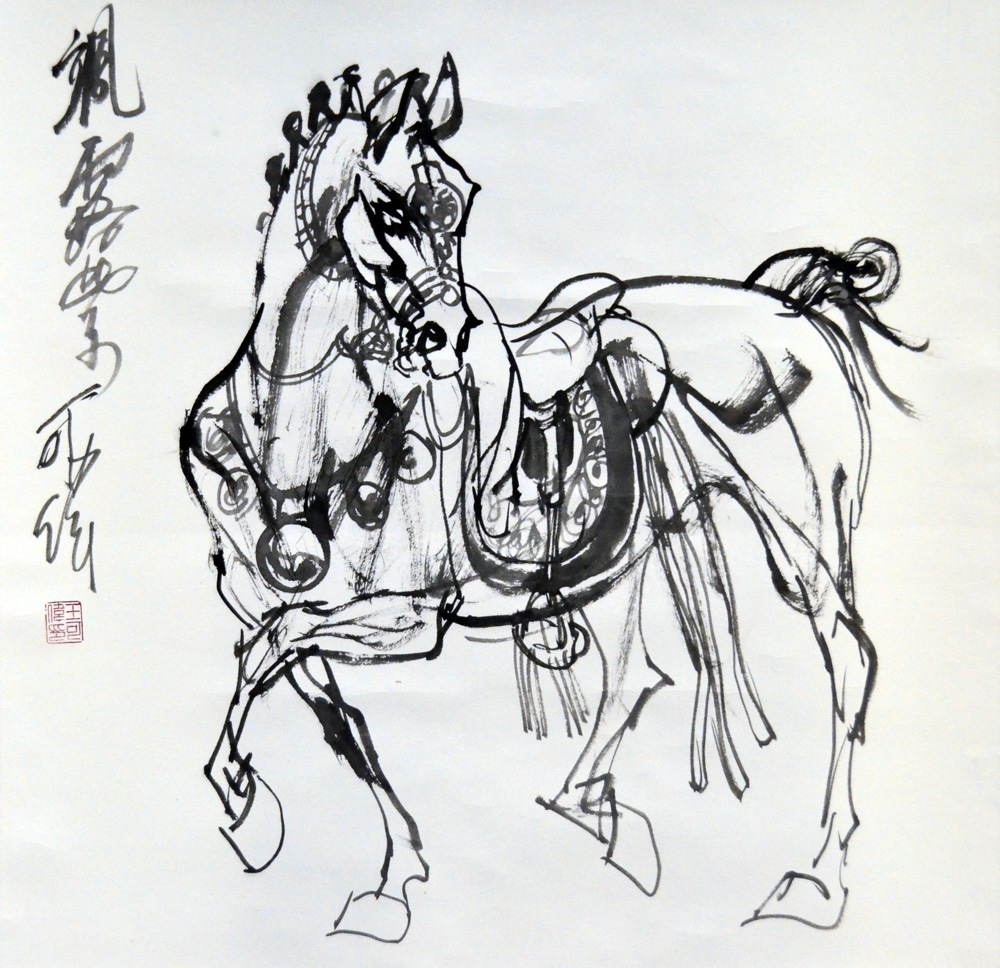
《飒露紫》墨写神骏·意驰千里
王可伟先生国画作品《飒露紫》2014年创作,画心尺寸:69cm×70cm,装裱后尺寸:81cm×165cm
作品介绍
墨写神骏,意驰千里
王可伟先生以写意笔墨描绘唐太宗李世民的著名战马——飒露紫。
飒露紫是唐太宗李世民南征北战时所骑的战马,也是著名的“昭陵六骏”之一。其名因毛色带紫而得名。公元621年前后,李世民率军与王世充争夺洛阳,曾骑乘飒露紫深入敌阵。激战之中,飒露紫胸前中箭,李世民在部将丘行恭的协助下突围。后来,李世民为纪念这些陪伴自己征战天下的战马,下令将六匹战马雕刻成石刻,立于昭陵之前。
作者没有拘泥于战马的细部刻画,而是以简劲、洒脱的线条捕捉飒露紫的神态与气势。马首低昂,鬃毛飞扬,四肢健硕,笔墨浓淡相间,在简练的黑白之间表现出骏马的雄健、沉着与蓄势待发。
尤其值得一提的是,飒露紫在“昭陵六骏”中具有独特的历史意义:现存的飒露紫石刻上,还刻有将军丘行恭为受伤战马拔箭的形象,是六骏中唯一带有人物形象的一件。
一笔一势见骨力,一马一神见风云。
这不仅是一匹骏马的绘画,也是作者对中国古代英雄时代与尚武精神的一种艺术追忆。王可伟先生借飒露紫之形,写骏马之神,也寄寓了中国古代英雄时代的豪迈气魄。
====================================================================
Wang Kewei — Saluzi
2014 | Chinese Ink Painting
Image size: 69 × 70 cm
Mounted size: 80 × 165 cm
Artwork Description
A Divine Steed in Ink, Galloping Across a Thousand Miles
In this work, Wang Kewei depicts Ziluzi, the famous warhorse ridden by Emperor Taizong of the Tang Dynasty, Li Shimin, through expressive Chinese ink painting.
Ziluzi was one of Li Shimin’s renowned warhorses during his military campaigns and is also one of the famous “Six Steeds of the Zhao Mausoleum.” Its name, meaning “Purple Dew,” is said to have derived from the purplish color of its coat.
Around 621 AD, Li Shimin led his troops in the campaign against Wang Shichong for control of Luoyang. He rode Ziluzi deep into the enemy ranks. During the fierce battle, Ziluzi was struck by an arrow in the chest, and Li Shimin escaped with the assistance of his general, Qiu Xinggong. Later, in memory of the warhorses that had accompanied him through his military campaigns, Li Shimin ordered six of his celebrated steeds to be carved in stone and placed before the Zhao Mausoleum.
Rather than focusing on meticulous details, the artist uses vigorous and spontaneous brushwork to capture the spirit and power of Ziluzi. With its lowered head, flowing mane, and powerful limbs, the horse appears poised for action. Through the interplay of varying shades of ink and concise lines, the painting conveys the horse’s strength, composure, and restrained energy.
Of particular historical significance is the stone relief of Ziluzi among the “Six Steeds of the Zhao Mausoleum.” It uniquely depicts the general Qiu Xinggong removing an arrow from the wounded horse, making it the only one of the six reliefs to feature a human figure.
Every stroke reveals strength; every gesture captures the spirit of the steed.
This is not merely a painting of a magnificent horse, but also an artistic remembrance of the heroic age and martial spirit of ancient China. Through the image of Ziluzi, Wang Kewei captures the spirit of the legendary steed while expressing the grandeur and heroic character of an age of ancient Chinese heroes.